The short answer
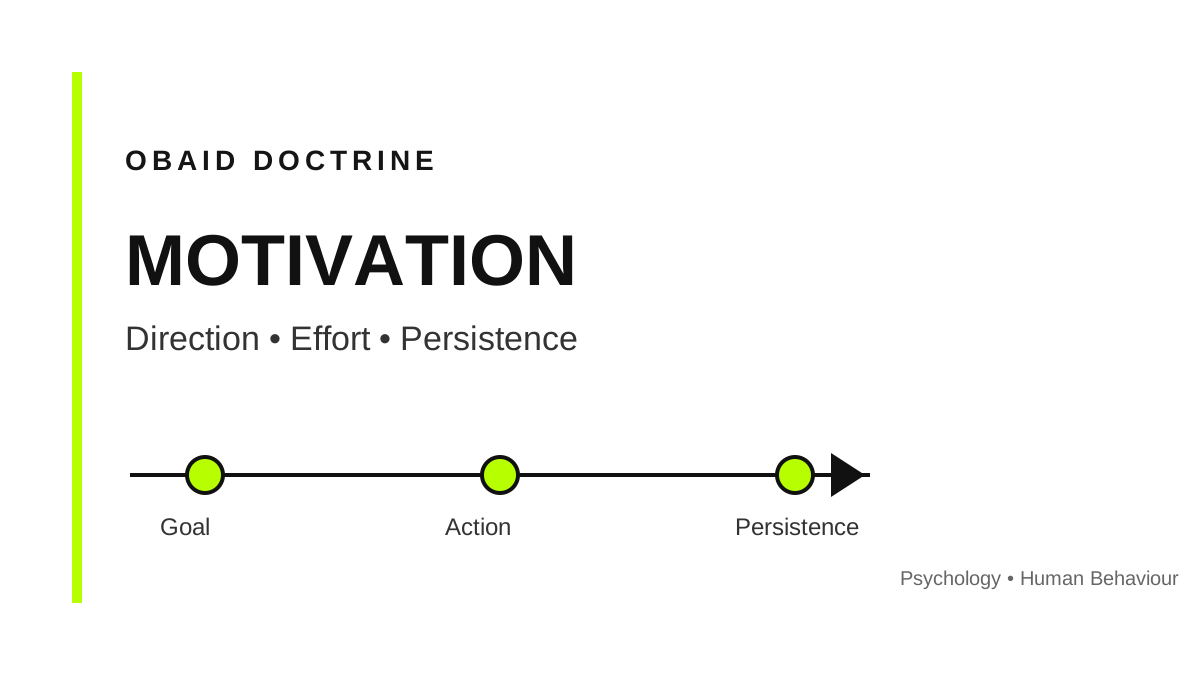
In psychology, motivation refers to processes that help activate, direct and sustain behaviour toward something a person wants, values or needs. A goal can influence what someone chooses, how much effort they invest and whether they continue after difficulty. Motivation is therefore not simply “feeling inspired.” It can operate when enthusiasm is low, and it can change as circumstances, expectations and goals change.
How does motivation influence behaviour?
A useful way to think about motivation is as a relationship between a desired outcome and the behaviour that may move a person toward it. The process is not perfectly linear, but a simple model is:
Need / Value / Goal → Motivation → Behaviour → Persistence or Adjustment
For example, two people may receive the same assignment but approach it differently. One may value learning the subject, another may mainly want the qualification, and a third may feel pressure from family or work. The visible behaviour can look similar while the underlying reasons differ. Research therefore treats motivation as multidimensional rather than as one fixed quantity.
Intrinsic and extrinsic motivation
Intrinsic motivation involves engaging in an activity because the activity itself is interesting, satisfying or enjoyable. Extrinsic motivation involves doing something for an outcome or consequence that is separate from the activity itself, such as a reward, grade, approval or avoiding a penalty.
The distinction is useful, but real behaviour is often more complicated than “intrinsic good, extrinsic bad.” A person can have several motives at the same time, and the reasons for doing something can change. OpenStax Psychology 2e notes that motivation can involve both intrinsic and extrinsic factors and that their mix may change over time. OpenStax: Motivation
External rewards can also have different psychological meanings. A reward experienced as controlling is not necessarily equivalent to feedback or recognition that supports a person's sense of competence or choice. This is one reason motivation research looks beyond the simple presence or absence of rewards.
What is Self-Determination Theory?
Self-Determination Theory (SDT) is one major framework for studying human motivation. It distinguishes different forms of motivation according to how autonomous or controlled the reasons for action are. A central part of the theory concerns three psychological needs: autonomy, competence and relatedness.
- Autonomy: experiencing one's actions as meaningfully chosen rather than simply forced.
- Competence: experiencing effectiveness and the ability to deal with challenges.
- Relatedness: experiencing connection, care and belonging with other people.
Research on SDT is extensive. A meta-analysis covering 486 samples and more than 205,000 participants examined the continuum of self-determined motivation and found substantial support for the predicted relationships among different forms of motivation, while also identifying areas where measurement models need care. Howard, Gagné & Bureau (2017), Psychological Bulletin
A separate meta-analysis of 344 samples and more than 223,000 participants examined student motivation and found that different forms of motivation were associated with different performance, well-being, goal-orientation and persistence outcomes. The authors also emphasized that multiple types of motivation can coexist. Howard et al. (2021), Perspectives on Psychological Science
How do goals and self-efficacy affect motivation?
Goals give behaviour direction. A vague intention such as “I want to improve” provides less information about what action should happen next than a specific, observable objective. But having a goal does not guarantee action: people also consider effort, expected outcomes, competing demands and whether they believe they can succeed.
Self-efficacy refers to a person's belief in their capability to perform a particular task. It is not the same as general self-esteem. A person can have high self-efficacy for one activity and low self-efficacy for another. Psychology research treats perceived capability as relevant to choices, effort and persistence, while recognizing that belief alone cannot overcome every external constraint.
This distinction matters for everyday behaviour. If someone wants to learn a difficult skill but expects that every attempt will fail, the perceived cost of starting may be high. Small experiences of successful performance, useful feedback and realistic task design can change what the person expects from future attempts. That does not mean “believe in yourself” is a universal solution; it means expectations can be one part of the motivational process.
Why does motivation change over time?
Motivation is sensitive to context. A task can become more or less attractive as its value, difficulty, social meaning, expected consequences or emotional experience changes. The same person may feel strongly motivated on one day and struggle to begin on another without either state revealing a permanent trait.
Social environments can matter as well. A teacher, parent, manager or teammate can create an environment that supports choice and competence—or one that feels controlling and discouraging. A 2022 meta-analysis of 144 studies involving more than 79,000 students found that autonomy-supportive behaviour was associated with psychological need satisfaction and self-determined motivation, with competence showing the strongest positive association among the three needs in that student evidence base. Bureau et al. (2022), meta-analysis
Motivation, self-control, discipline and habits are not the same
These concepts are related, but treating them as synonyms creates confusion.
- Motivation concerns the processes that energize and direct behaviour toward goals, needs or valued outcomes.
- Self-regulation concerns monitoring and adjusting thoughts, emotions or behaviour in relation to goals or standards.
- Self-control often refers more specifically to managing impulses or immediate responses when they conflict with longer-term aims.
- Discipline is an everyday term for consistently carrying out intended behaviour; it is not a single psychological construct that explains everything.
- Habits are learned behavioural patterns that can become more automatic in recurring contexts.
This is why a person can be motivated but still fail to act, or act consistently without feeling highly motivated at every moment. Motivation is one part of a larger behavioural system.
OBAID DOCTRINE already explores this distinction through How Habits Form and Why They Are Hard to Change and Why Do We Procrastinate? The Psychology of Delay. Procrastination, in particular, can involve motivation, task characteristics, emotion, attention, self-regulation and context rather than one missing ingredient.
Why “just get motivated” is an incomplete explanation
Popular advice often treats motivation as a fuel tank that can simply be filled with enough inspiration. Psychology provides a more useful picture. A person may value a goal and still face an unclear task, low perceived capability, competing rewards, social pressure, fatigue, limited resources or an environment that makes the desired behaviour difficult.
Changing the environment can therefore matter as much as changing one's internal state. Making a desired action easier to start, clarifying the next step, reducing unnecessary friction or creating supportive social conditions can alter the behavioural context in which motivation operates.
What does research actually tell us about motivation?
Motivation is not one measurable substance that every person possesses in a fixed amount. Different theories measure different constructs, and research findings can depend on the population, task, setting and outcome being studied.
For example, meta-analytic evidence supports meaningful relationships between forms of self-determined motivation and outcomes such as persistence and well-being, but those findings should not be converted into a universal rule that one type of motivation always produces one result. The 2017 meta-analysis also found heterogeneity in the relationships among motivation constructs, illustrating why precise measurement matters. PubMed: motivation continuum meta-analysis
Likewise, intervention research can identify ways of supporting motivation in particular settings, but an intervention tested in one population should not automatically be treated as a guaranteed solution for everyone. Evidence is strongest when claims match the population, design and outcome actually studied.
A simple way to understand motivation in everyday life
When a behaviour feels difficult to start, instead of asking only “Why am I not motivated?”, ask a more precise set of questions:
- What outcome matters to me?
- What makes this outcome valuable—or not valuable—right now?
- Do I believe I can perform the next step?
- What immediate reward or discomfort is competing with the goal?
- Does my environment support the behaviour I intend to perform?
- What could I change about the task, context or next step?
These questions are not a diagnostic test. They are a way to turn a vague label—“I lack motivation”—into several testable possibilities.
OBAID DOCTRINE FRAMEWORK
Why → Value → Capability → Action → Persistence
Motivation becomes easier to understand when we examine why an outcome matters, what value it has, whether the person expects to be capable, what action follows, and what keeps the behaviour going or causes it to change.
OpenStax Psychology 2e — Motivation
PubMed — Testing a continuum structure of self-determined motivation: A meta-analysis
PubMed — Student Motivation and Associated Outcomes: A Meta-Analysis From Self-Determination Theory
PMC — Pathways to Student Motivation: A Meta-Analysis
PMC — Integrative review of Self-Determination Theory